






4 Warning Signs a Tree Is at Significant Risk of Crashing Down in High Winds
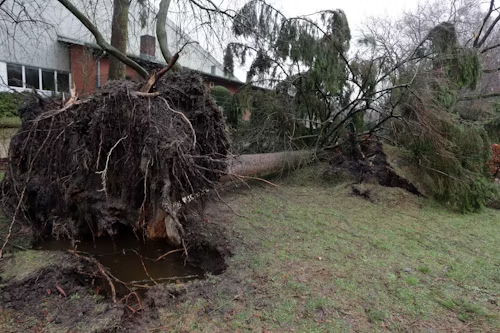
A weakened tree can become a serious hazard when high winds move through the area. Strong gusts place additional stress on trunks and root systems, potentially causing unstable trees to topple or large limbs to break. Recognizing signs of structural weakness before severe weather arrives can help you take action to reduce potential risks. At Tree Health, our local ISA-certified arborists provide hazardous tree identification and removal in the greater Hicksville, NY area. Here are four warning signs that a tree may be at significant risk of falling during high winds.
The Tree Has Developed a New Lean
A noticeable lean does not necessarily mean a tree is dangerous, since some trees naturally grow at an angle. However, a tree that has recently started leaning or whose angle appears to be increasing deserves professional attention. Changes in the soil around the base, exposed roots, or a raised section of ground may indicate movement in the root system. An arborist can evaluate whether the tree remains structurally stable.
Large Cracks in the Trunk
Large cracks or splits in the trunk can compromise a tree’s structural strength. Cracks may develop because of storms, heavy limbs, disease, decay, or other forms of stress. Deep vertical cracks or areas where major sections of the trunk are separating can be especially concerning. Because structural damage may worsen when strong winds push against the canopy, prompt professional inspection is recommended.
Roots Are Damaged or Exposed
A healthy root system helps anchor a tree securely in the ground. Erosion, disease, excavation, or changing soil conditions can damage roots and potentially reduce stability. Exposed roots, significant soil movement, or visible decay around the base may indicate an underlying problem. If you notice changes around the tree’s root zone, have the tree assessed by an arborist.
Signs of Decay
Decay can weaken important structural portions of a tree while remaining difficult to detect from the outside. Hollow areas, cavities, fungal growth, soft or damaged wood, dead sections, and significant bark deterioration can indicate internal problems. A tree affected by extensive decay may be less capable of withstanding high winds. Professional assessment can help determine the tree’s condition and whether pruning, support, or removal is appropriate.
Hazardous Tree Removal in Hicksville, NY
For
expert tree removal in Hicksville, NY and the surrounding area, contact Tree Health at
516-268-3745. Feel free to give us a call to
arrange an arborist estimate in greater Hicksville!